
No products in the basket.
NEW


Panzer Tracts No.5-3: Pz.Kpfw. Panther Ausführung G
£32.99
The 1:16 scale plans have now sold out
In stock
Panzer Tracts No.5-3: Pz.Kpfw. Panther Ausführung G
Researched and written by Hilary Doyle and the late Thomas Jentz, this completely revised edition of Panzer Tracts No.5-3 Panther Ausf.G represents 23 years of accumulated research since the original 2004 publication. Where the first edition established the baseline, this new edition stands as the most comprehensive and technically exacting single-volume reference on the Panther Ausf.G ever produced.
As with every Panzer Tracts title, the work is grounded exclusively in original period documentation, physical surveys of surviving vehicles and components, and period photography. No speculation. No received wisdom. Just meticulously verified facts.
This upgraded edition features:
- Twice the size of the original book at 136 pages. Fully revised content, including newly uncovered historical and technical information.
- 116 large, high-resolution photographs, an increase of no less than 87(!) images, all reproduced to the highest possible quality.
- 54 pages of precisely dimensioned CAD drawings in 1:35, 1:20 and 1:10 scales, created to original Panther manufacturer tolerances and assembly standards — the most accurate Ausf.G plans ever published. Eleven more pages than the original.
The achievement behind this book is considerable. It required over fifty trips to public museums and private collectors across Europe and the USA to precisely measure surviving Panther Ausf.G and their components, thousands of research hours across multiple archives, and over 1,100 hours spent producing the CAD drawings alone.
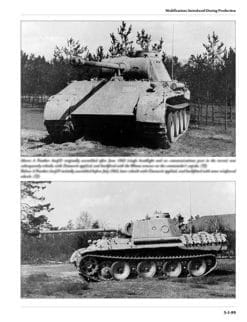
The result is a book that traces the complete history of the Ausf.G from the design conference at M.A.N. on 4 May 1943 through to the last Panthers assembled by Daimler-Benz in April 1945, covering every aspect of development, production, modification, and operational use. Wanne and Turmgehäuse manufacture is covered by suppliers, with observed serial number bands listed. The infra-red equipped Panthers receive increased coverage, including drawings of the FG 1250 infra-red searchlight and scope assembly. Operational experience is drawn from unit records on all fronts, including first-hand accounts, and extends to the Ardennes Offensive and the final defensive battles of 1945.
Whether you are a military historian, technical researcher, or scale modeller, this is the definitive reference on the Panther Ausf.G.
The 1:16 scale plans have now sold out
Book Data
Authors: Thomas Jentz & Hilary Doyle
ISBN: 9781915969200
Language: English
Pages: 136
Photos: 116
CAD Drawings: 54 pages of 1:35, 1:10 and 1:20 scale CAD drawings
Physical: Softcover, 280x215mm, portrait
Contents
- Introduction
- Panzerkampfwagen Panther Ausführung G
- Panzerbefehlswagen Panther (Sd.Kfz.267 & 268)
- Production
- CAD Drawings
- Modifications Introduced During Production
- Interior
- Operational Experience with the Panther Ausf.G
Improvements over the 2004 Edition
- 68(!) more pages
- 87(!) more photographs
- Eleven more pages of CAD drawings, updated with the latest information
- Rewritten text, updated with the latest information
- Reworked images for clarity and tonal quality
- Clearer layout and navigation
- Handy modifications table on the back cover for quick reference
- Table of Contents
- Title on the spine
- Perfect bound for durability
Website Reviews
Panzer-Modell.eu (German)
About the Authors

Hilary L Doyle
Author
Hilary initially trained as a civil engineering draughtsman with the Irish Railways, but later achieved Chartered Engineer status. In 1967, he became a pioneer of technical desktop computing in Ireland. From 1973, his professional career was in management in the computer industry, and he was awarded a Fellowship of the Irish Computer Society. Hilary lives with his wife near Dublin and has eight grandchildren.
Thomas L Jentz ✟
Author
Tom was from Indiana and spent a year at Purdue University before serving in an armoured unit of the US Army in Germany, later completing nuclear training with the Army. After returning to civilian life, he worked as a nuclear health physicist and consultant to the nuclear industry, living with his family near the US National Archives in Washington, DC. His interest in military history was shaped by stories from his Uncle Ed, who the Wehrmacht had captured in North Africa after an action in which 100 Sherman tanks were destroyed. Tom died in 2012.
You may also like…

-4%

-5%